
“As of 2025, 91% of organisations globally are using at least one AI technology in the workplace—marking one of the fastest adoption curves in modern business history.” [azumo.com]
The conversation around artificial intelligence (AI) has evolved rapidly in recent years, often accompanied by a mix of excitement, uncertainty, and misinformation. While headlines frequently focus on the disruptive potential of AI, it’s important to remember that this technology is not new. Many of us have been interacting with AI for over a decade – Siri entered our lives in 2010, followed by Alexa in 2014. Today, AI is embedded in everything from our smartphones to our workplaces.
There’s no denying that AI is transforming how we work. From automating routine tasks to enhancing decision-making through data analysis, its capabilities are expanding at an astonishing pace. However, despite these advancements, AI still has limitations, particularly when it comes to replicating the nuanced, human-centric skills that drive innovation, collaboration, and leadership.
10 Human Capabilities AI Still Can’t Replicate
- Common Sense Reasoning: Humans possess an intuitive grasp of everyday logic and context that AI continues to struggle with.
- Empathy and Emotional Intelligence: The ability to understand, interpret, and respond to emotions with genuine empathy remains uniquely human.
- Creativity and Originality: While AI can mimic patterns, true innovation and artistic expression stem from human imagination.
- Understanding Unstructured Data: Humans excel at interpreting abstract concepts, stories, and visuals in ways that AI cannot fully emulate.
- Contextual Awareness: People adapt their communication and decisions based on subtle shifts in context – something AI often misses.
- Physical Dexterity: Complex motor skills and adaptability in dynamic environments are still beyond AI’s reach.
- Ethical and Moral Judgement: Navigating ethical dilemmas requires a depth of cultural, emotional, and moral understanding that AI lacks.
- Adaptability to Novel Situations: Humans can think on their feet and respond creatively to unforeseen challenges.
- Nuanced Language Use: Sarcasm, humour, and cultural references are difficult for AI to interpret and generate accurately.
- Genuine Insight and Wisdom: Humans synthesize experiences and knowledge to form deep insights – AI processes data but does it truly “understand.”
As AI continues to evolve, the question isn’t whether it will replace humans, but how organisations will integrate these technologies alongside their workforce. The key lies in empowering employees with the right skills, mindset, and adaptability to work effectively with AI, not against it.
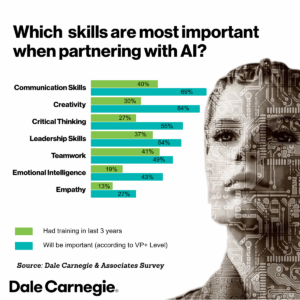
Organisations that invest in developing human capabilities such as communication, leadership, resilience, and emotional intelligence will be best positioned to thrive in this new era. By fostering a culture of continuous learning and human-centred innovation, businesses can ensure that technology enhances rather than replaces the human touch.